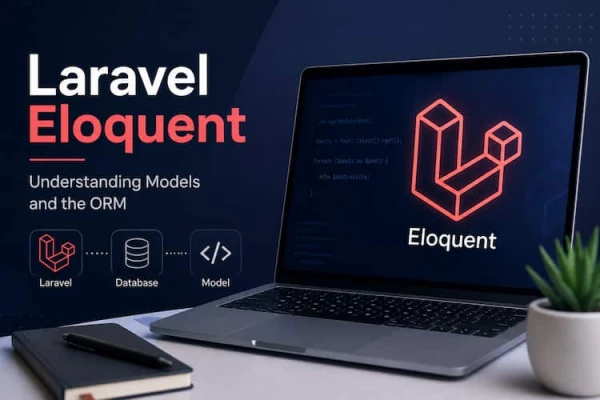
What Is Laravel Eloquent? Understanding Models and Laravel's ORM
Every modern web application depends on data. Whether users are creating accounts, publishing articles, placing orders, sending messages, or updating their profiles, every action eventually results in information being stored, retrieved, updated, or removed from a database. Without an efficient way to manage that data, even the most carefully designed application would quickly become difficult to maintain.
When developers first begin learning Laravel, one of the biggest surprises is discovering how little SQL they actually need to write. Instead of manually creating complex database queries for every operation, Laravel provides an elegant solution called Eloquent. Rather than thinking about tables, rows, and SQL syntax, developers work with PHP objects called models that naturally represent the information inside the database.
This approach changes the entire development experience. Instead of asking the database for rows, developers interact with users, products, posts, and orders as if they were ordinary PHP objects. Behind the scenes, Laravel translates those operations into the SQL queries required by the database, allowing developers to focus on building applications instead of repeatedly writing database commands.
Understanding Eloquent is one of the most important steps in becoming a Laravel developer. Nearly every Laravel application depends on it in some way. Whether you are creating a simple blog, an e-commerce platform, a customer management system, or a REST API, Eloquent is responsible for connecting your application's business logic with its database.
Before information reaches Eloquent, it usually travels through several other Laravel components. A request enters the application through the routing system, may pass through one or more middleware layers, is often validated to ensure that the submitted data is acceptable, and is then processed by a controller before finally interacting with the database. If these concepts are still new to you, consider reading Laravel Validation Explained, Understanding Laravel Routing, and What Is Middleware in Laravel? first, as they provide the foundation for understanding how data eventually reaches Eloquent.
By the end of this guide, you will understand not only what Laravel Eloquent is, but also why it has become one of the framework's most powerful and widely appreciated features.
What Is Laravel Eloquent?
Imagine managing a large library that contains thousands of books. Every book has a title, an author, a publication date, a category, and many other pieces of information. One way to organize this library would be to manually search through shelves every time you wanted to find or update a book. While possible, the process would quickly become slow, repetitive, and difficult to manage.
Now imagine that every book had its own digital profile. Instead of searching shelves manually, you simply work with the book itself. If you want to change its title, you edit the title. If you want to know the author, you read the author's information directly from the profile.
Laravel Eloquent follows a very similar philosophy.
Instead of treating database records as anonymous rows inside tables, Eloquent represents every record as a PHP object called a Model. A user becomes a User model. A blog article becomes a Post model. A product becomes a Product model. Each model represents a specific type of information stored within the application's database.
This object-oriented approach makes applications significantly easier to understand. Rather than thinking about SQL statements throughout your project, you think about the real-world objects your application manages. This creates code that is more expressive, easier to maintain, and far more enjoyable to work with.
Eloquent is Laravel's implementation of an Object-Relational Mapper, commonly referred to as an ORM. An ORM acts as a bridge between object-oriented programming and relational databases. It translates PHP objects into database operations and converts database records back into PHP objects that your application can easily use.
Rather than replacing SQL entirely, Eloquent simply provides a more natural way of interacting with your database. Developers can still use SQL whenever necessary, but for the majority of everyday tasks, Eloquent provides a cleaner and more readable solution.
Because of this flexibility, Eloquent has become one of the defining features of Laravel and one of the primary reasons many developers choose the framework for both small and enterprise-level applications.
Why Laravel Uses an ORM
When developers first learn databases, they usually begin by writing SQL queries directly. This approach works perfectly well for simple projects, but as applications become larger, repeatedly writing similar queries starts creating unnecessary complexity.
Consider a typical web application.
Every day it retrieves users, stores new articles, updates customer information, deletes expired records, counts products, searches categories, and performs countless other database operations. Writing raw SQL for every one of these tasks quickly results in repetitive code scattered throughout the project.
Laravel addresses this challenge by introducing Eloquent.
Instead of manually describing every database operation using SQL syntax, developers describe what they want to accomplish using models. Eloquent then generates the appropriate database queries behind the scenes.
This abstraction provides several important advantages.
First, the application's code becomes significantly easier to read. When another developer opens your project months later, they immediately understand that the application is working with users, products, or orders instead of deciphering long SQL statements spread across multiple files.
Second, Eloquent encourages consistency throughout the application. Since developers interact with models rather than writing unique SQL queries in different locations, projects become easier to organize and maintain as they grow.
Finally, Eloquent integrates naturally with many other Laravel features. Controllers frequently retrieve models before returning responses. Validation ensures that incoming data is suitable before it is stored through Eloquent. Relationships allow models to communicate with one another, making complex applications feel surprisingly simple to develop.
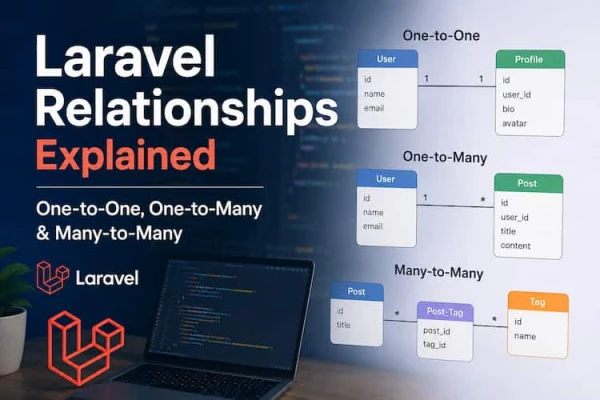
If you have already read Laravel Relationships Explained, you have already seen one of Eloquent's most powerful capabilities. Relationships are built directly on top of Eloquent models, allowing applications to understand how users, posts, comments, products, and many other entities are connected without requiring developers to manually join tables every time they retrieve information.
Understanding why Laravel uses an ORM therefore goes beyond convenience. It represents a design philosophy centered on readability, maintainability, and developer productivity. Rather than constantly thinking about database syntax, developers can focus on solving business problems while Eloquent quietly handles much of the communication with the database behind the scenes.
Understanding Laravel Models
If Eloquent is the engine that powers Laravel's database interactions, then Models are the vehicles that carry your application's data.
Every model represents a specific type of information stored inside your database. A blogging platform may contain models for users, posts, categories, comments, and tags. An online store might use models for products, customers, orders, payments, and shipments. Although these objects represent completely different kinds of information, Laravel allows developers to interact with all of them in a remarkably consistent way.
This consistency is one of Eloquent's greatest strengths.
Rather than learning different techniques for every database table, developers learn how models work once and then apply the same concepts throughout the entire application. Whether the application contains five tables or five hundred, the overall development experience remains familiar and predictable.
Models also make applications easier to understand because they closely represent real-world concepts. Instead of thinking about anonymous database rows, developers work with meaningful objects such as a customer placing an order or an author publishing a new article. This object-oriented approach keeps business logic organized and significantly improves the readability of large projects.
As your application grows, models become central to many other Laravel features. Controllers frequently communicate with models to retrieve information before returning responses. Validation ensures that only correct information reaches those models, while relationships define how different models connect with one another.
How Eloquent Connects to the Database
One of the reasons developers enjoy working with Laravel is that Eloquent hides much of the complexity involved in communicating with a relational database.
Behind every operation performed by Eloquent, Laravel automatically generates the SQL statements required to interact with the database. Developers continue working with PHP objects, while Eloquent quietly translates those actions into queries that MySQL, PostgreSQL, SQLite, or SQL Server can understand.
This separation allows developers to think about their application's business logic instead of constantly switching between PHP code and SQL syntax.
Imagine building a content management system where editors publish hundreds of articles every week. Instead of repeatedly writing database queries for every operation, developers simply work with the Article model throughout the application. Eloquent takes responsibility for generating the necessary database operations, reducing repetitive code and making future maintenance significantly easier.
This architecture also improves consistency. Because every part of the application communicates with the database using the same system, projects remain easier to organize as they become larger. Whether information is retrieved from a controller, processed by a scheduled task, or returned through an API, Eloquent provides a familiar and predictable development experience.
When Should You Use Laravel Eloquent?
Laravel Eloquent is designed for the vast majority of everyday database operations. Whenever your application needs to create, retrieve, update, or delete information related to users, products, blog posts, orders, or other business entities, Eloquent is usually the most natural choice.
Because Eloquent works with models instead of raw database records, it encourages developers to write code that is easier to read and maintain. As applications become larger, this consistency makes projects significantly easier to understand, especially when multiple developers are working together.
Eloquent is also the foundation for many other Laravel features. Relationships, model events, factories, and resource controllers all build upon Eloquent models, making it an essential part of the framework rather than an optional component.
Although Laravel also provides the Query Builder and allows developers to execute raw SQL when necessary, most Laravel applications rely on Eloquent for their day-to-day database interactions. For beginners, mastering Eloquent first provides the strongest foundation before exploring more specialized database techniques.
Eloquent vs Query Builder
One question that every Laravel developer eventually asks is whether Eloquent should always be used instead of the Query Builder.
The answer is more balanced than many beginners expect.
Eloquent is designed around models and object-oriented programming. It makes applications easier to read because developers work directly with meaningful business objects rather than database structures. For the majority of web applications, this leads to cleaner, more maintainable code that is easier to understand months or even years later.
The Query Builder approaches the same database from a different perspective. Instead of working with models, developers interact more directly with database tables while still benefiting from Laravel's expressive syntax. This approach can be useful when performing highly customized queries or generating complex reports where models provide little additional value.
Neither approach replaces the other.
Instead, Laravel gives developers the flexibility to choose the most appropriate solution depending on the problem they are solving. Many successful Laravel applications use both Eloquent and the Query Builder together, selecting whichever approach provides the greatest clarity for a particular task.
For beginners, however, learning Eloquent first is generally the better choice because it introduces the core concepts that appear throughout nearly every Laravel application.
Common Misconceptions About Laravel Eloquent
Because Eloquent simplifies database interactions so effectively, many beginners develop misunderstandings about what it actually does.
One common misconception is that Eloquent eliminates the need to understand databases. While Eloquent removes much of the repetitive work involved in writing SQL, developers still benefit enormously from understanding tables, relationships, indexes, normalization, and database design. Strong database knowledge ultimately leads to better Laravel applications.
Another misunderstanding is that Eloquent replaces SQL entirely. In reality, Eloquent generates SQL behind the scenes. Understanding basic SQL remains valuable because it helps developers optimize queries, troubleshoot performance issues, and better understand how their applications interact with the database.
Some developers also believe that Eloquent is suitable for every possible database operation. Although it performs exceptionally well in most situations, extremely specialized reporting or large-scale analytical queries may occasionally benefit from alternative approaches. Laravel's flexibility allows developers to choose the right tool without abandoning Eloquent altogether.
Recognizing these misconceptions helps developers appreciate Eloquent for what it truly is: a powerful abstraction that improves productivity while still relying upon solid database fundamentals.
Best Practices for Using Eloquent
Learning how Eloquent works is only the beginning. Using it effectively requires adopting habits that keep applications maintainable as they grow.
One of the most important practices is to think about models as representations of real business concepts rather than simple database tables. Well-designed models make applications easier to understand because they describe users, products, orders, articles, and other meaningful entities instead of anonymous records.
It is equally important to keep business logic organized. As applications become larger, placing database-related behavior inside appropriate models helps reduce unnecessary complexity in controllers and other parts of the project.
Developers should also avoid viewing Eloquent as a replacement for good application architecture. It works alongside routing, middleware, validation, controllers, and authentication to create a complete Laravel application. Each component has a specific responsibility, and together they form a clean and maintainable development workflow.
Finally, continue expanding your understanding of Eloquent by learning about relationships, eager loading, scopes, collections, and model events. These advanced concepts build naturally upon the foundation introduced in this guide and allow developers to create increasingly sophisticated Laravel applications.
Frequently Asked Questions
What is Laravel Eloquent?
Laravel Eloquent is Laravel's built-in Object-Relational Mapper (ORM). It allows developers to interact with database records through PHP models instead of writing SQL queries for every operation.
Is Eloquent an ORM?
Yes. Eloquent is Laravel's official ORM and serves as a bridge between object-oriented PHP code and relational databases.
What is a Laravel Model?
A model represents a specific type of data stored in the database. Every model corresponds to a business entity, such as a user, product, order, or blog post.
Should beginners learn Eloquent before SQL?
No. Although Eloquent makes database interactions easier, understanding basic SQL remains an important skill for every Laravel developer.
What is the difference between Eloquent and the Query Builder?
Eloquent works with models and business objects, while the Query Builder interacts more directly with database tables. Both are valuable and often used together within the same application.
Conclusion
Laravel Eloquent is far more than a convenient way to communicate with a database. It represents one of the framework's defining features, transforming database interactions into an elegant, object-oriented experience that improves readability, maintainability, and developer productivity.
Rather than forcing developers to think in terms of tables and SQL statements throughout an application, Eloquent allows them to focus on the real-world entities their software manages. As applications grow larger and more complex, this approach becomes increasingly valuable, helping teams build software that remains organized, scalable, and easier to maintain.
Understanding Eloquent also opens the door to many other Laravel concepts, including models, relationships, collections, migrations, factories, and advanced database design. By mastering these building blocks, developers gain a much deeper understanding of how Laravel applications are structured and why the framework has become one of the most popular choices for modern PHP development.
Related Articles
- Laravel Validation Explained: How Laravel Protects Your Application from Invalid Data
- Laravel Relationships Explained: One-to-One, One-to-Many & Many-to-Many
- Understanding Laravel Routing
- What Is Middleware in Laravel?
- Laravel Form Not Submitting: Why Nothing Happens When You Click Submit
- Laravel 419 Page Expired Error: 9 Proven Fixes
- Laravel Session Expired – Causes and Complete Fix Guide
- Understanding Laravel Service Providers: A Beginner Friendly Guide





































Discussion 0