Laravel 500 Server Error — Why It Happens After Deploy or During Development
Few things feel more frustrating than opening your Laravel website and seeing nothing but a blank page or a message that simply says 500 Server Error. There is no detailed explanation, no obvious hint about what went wrong, and no clear connection between what you just changed and the error that suddenly appeared. Everything might have been working perfectly a moment ago, and now the entire application refuses to respond.
For many developers, especially those still learning Laravel, this moment creates a strange sense of uncertainty. Unlike validation errors or missing routes, the Laravel 500 server error does not tell you exactly where the problem lives. The page disappears, the browser shows a generic message, and the framework seems silent about what actually failed.
What makes the situation even more confusing is that the error often appears when nothing seems obviously broken. The code looks fine, the routes are still there, the controllers exist, and yet the server stops the request before Laravel can display anything useful. It feels less like a normal bug and more like the entire application collapsed somewhere behind the scenes.
This guide is written for that moment. Instead of treating the 500 error as a mysterious failure, we will explore what it actually represents inside a Laravel application, why it appears so frequently after deployment or structural changes, and what it reveals about the deeper relationship between your code, your environment, and the way Laravel processes requests.
Why the Laravel 500 Server Error Feels So Different From Other Errors

One of the reasons the internal server error in Laravel feels so discouraging is that it does not behave like most framework errors. Normally, Laravel is very good at explaining problems. If a route is missing, you see a clear message. If a controller cannot be resolved, Laravel tells you exactly which class it could not find.
One well-known example of that situation is the error “Target class does not exist,” which usually appears when Laravel cannot resolve a controller or service class correctly. If you have encountered that message before, you may find this explanation helpful: Target Class Does Not Exist in Laravel — Why the Controller Exists but Laravel Cannot See It.
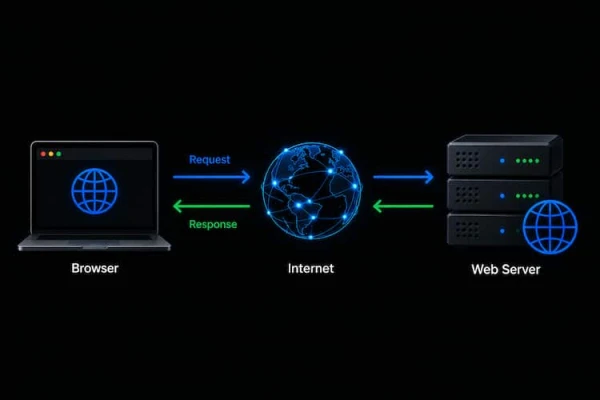
But a 500 error is different. It is not a detailed explanation; it is the final signal that something went wrong during the request lifecycle. Instead of describing the cause, the server simply reports that it could not complete the request safely.
This difference is important. When you see a Laravel 500 server error, you are not necessarily looking at the root problem. You are looking at the consequence of something that happened deeper inside the application. The real cause may live in the environment configuration, the deployment structure, a dependency conflict, or a subtle mistake that prevented Laravel from finishing the request normally.
In some situations the issue appears when handling forms or sessions, which can trigger another common Laravel problem known as the 419 Page Expired error. If that situation sounds familiar, you can explore it in more detail in How to Fix the 419 Page Expired Error in Laravel.
Because the message is so general, developers often feel lost when they encounter it for the first time. It feels as if the application has failed without leaving a trail behind. In reality, the trail usually exists; it is simply hidden in places beginners have not learned to check yet.
Why This Error Often Appears After Deploying a Laravel Project

One of the most common situations where developers encounter a Laravel 500 error after deploy is immediately after moving a project from localhost to a live server. On your local machine, everything might have worked perfectly. Pages loaded normally, forms submitted correctly, and the application behaved exactly as expected.
Then the project is uploaded to a shared hosting environment, a VPS, or a production server, and suddenly the browser returns a 500 error instead of your application.
This experience feels especially confusing because the code did not change. The database may even be identical. From the developer’s perspective, nothing should have broken. But from the server’s perspective, many things have changed.
The environment where your application runs plays a much larger role than many beginners initially realize. PHP versions, server permissions, installed extensions, environment variables, cache states, and folder structures can all influence how Laravel behaves once it leaves your development machine.
When those surrounding conditions differ from the environment where the project was originally tested, Laravel may encounter situations it cannot resolve safely. The framework stops the request, and the server returns the message that developers eventually learn to recognize: 500 Server Error.
This pattern appears in many deployment-related problems. For example, developers who deploy Laravel projects to shared hosting sometimes discover that images disappear after deployment because the storage link behaves differently on the server. That experience is explored in more detail in Laravel Storage:link Not Working on cPanel (Images Missing After Deploy), which shows how environment differences can quietly break features that worked perfectly during development.
The Hidden Causes Behind a Laravel 500 Server Error

The reason the Laravel server error feels so difficult to diagnose is that it rarely points to a single obvious cause. Instead, it represents a wide range of potential issues that prevent Laravel from completing the request lifecycle normally.
Sometimes the cause is environmental. The server may lack an extension that Laravel expects, or an environment variable may be missing from the configuration. Other times the cause is structural, such as a dependency that is no longer available or a class that cannot be resolved during execution.
In some cases, the problem appears after changes in the project itself. A developer may reorganize folders, modify configuration files, or introduce new packages without realizing how those changes affect the internal structure of the application. When Laravel attempts to process the request under those new conditions, something fails during execution, and the framework never reaches the stage where it can display a friendly error page.
Because the browser only receives the final signal from the server, developers often experience the internal server error Laravel message as a wall rather than a clue. The page disappears, and the error provides almost no context.
Why Laravel Projects Become More Sensitive as They Grow

Interestingly, the Laravel 500 server error often appears not only during deployment but also when projects become more complex. As applications grow, developers begin introducing additional layers: service classes, middleware, caching strategies, API integrations, and other architectural improvements.
These changes make the project more powerful, but they also increase the number of moving parts inside the application. When more systems interact, the chances of unexpected conflicts increase as well.
A small inconsistency in configuration, an overlooked dependency, or a misaligned environment variable can ripple through the request lifecycle and cause Laravel to stop execution before the response is returned.
This is one reason why developers who begin refactoring their projects sometimes encounter server errors they had never seen before. Improving architecture is important, but structural changes also require careful alignment with the framework’s expectations. That idea connects closely with the principles explored in How to Refactor and Improve a Laravel Project Without Breaking Everything.
What the Laravel 500 Error Teaches You as a Developer

Although the Laravel 500 server error can feel intimidating at first, it eventually becomes one of the most valuable learning experiences in the framework. Unlike smaller mistakes that can be fixed quickly, this error forces developers to step back and think about the entire application environment.
It reminds you that a Laravel project is not only code. It is also configuration, server infrastructure, dependencies, permissions, and the invisible systems that allow everything to work together.
Many developers describe this stage as the moment when Laravel stops feeling like a simple tool and starts revealing itself as a complete ecosystem. The framework is no longer just about routes and controllers; it becomes a system where environment, architecture, and execution flow all matter.
Experiences like this often become part of a developer’s journey, something I reflected on in My Biggest Laravel Learning Mistakes and My First Laravel Project: How One Simple App Changed Everything, where unexpected problems eventually became some of the most valuable lessons in learning the framework. Laravel Deployment Errors — Complete Fix Guide




































Discussion 0