
Laravel Works Locally but Not on Server — The Hidden Differences You Must Understand Laravel developer
⚡ Quick Fix (Try This First)
👉 Before you overthink it, run this:
php artisan optimize:clearcomposer install --no-dev --optimize-autoloaderchmod -R 775 storage bootstrap/cachecomposer dump-autoload✅ Then check:
- Your `.env` matches production
- Your server points to `/public`
👉 This fixes most “works locally but not on server” issues.
In many cases, these deployment issues are deeply connected to how Laravel handles environments and cached configuration internally. This is explained more deeply in Understanding Laravel Environment Configuration — How Laravel Thinks Behind the Scenes.
Common Issues (With Real Examples)
- If you see a blank page or crash → often related to a Laravel 500 Server Error — Why It Happens After Deploy or During Development
- If controllers don’t respond → similar to cases where Laravel cannot resolve logic properly Laravel Controller Not Working — Why Your Code Looks Right but Nothing Happens Laravel developer
- If images are missing → usually a storage/permissions issue (like storage link problems) Laravel Storage:link Not Working on cPanel (Images Missing After Deploy)
- If frontend breaks → often related to build issues (like missing Vite manifest) Vite Manifest Not Found in Laravel (Beginner-Friendly Explanation and Fix)
- If login fails → usually sessions or CSRF problems Laravel Login Not Working? (Session, CSRF, Redirect Fix Guide)
- If routes return 404 → often server config or routing issues laravel route not working 404 error complete fix guide
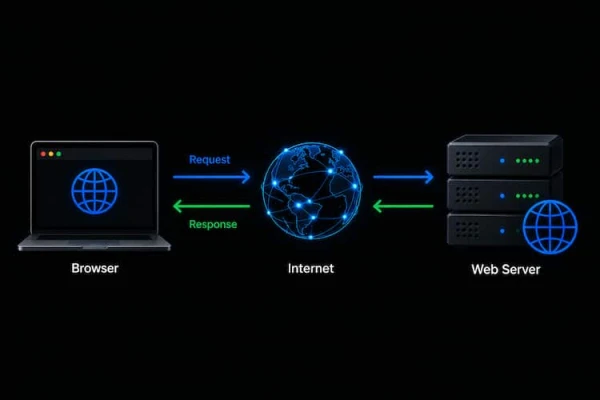
- How a Web Browser Works: From URL to Web Page
👉 These issues feel random — but they’re almost always environment-related.
What’s Actually Happening (Short Version)
Laravel doesn’t just run your code — it runs inside an environment.
Many developers only discover this after deployment, when cached configuration or outdated environment values suddenly change application behavior. This connects closely with Laravel .env Not Working? Fix Config Cache Problems.
It depends on:
- Environment variables
- Cache
- File system
- Server configuration
That’s why people search:
- laravel works locally but not on server
- laravel not working after deploy
Full Explanation (If You Want to Understand It Deeper)
You build your Laravel project step by step, carefully shaping every part of it, testing every feature on your local machine, watching everything work exactly as expected, and slowly building that quiet confidence that your application is stable and ready to be deployed.
Then you deploy…
…and everything starts to feel different in a way that is difficult to explain but impossible to ignore.
Routes stop responding the same way, images disappear without warning, forms behave unpredictably, sessions expire at the wrong time, and sometimes you are left staring at a blank page or a server error with no clear explanation.
The confusion doesn’t come from complexity alone, but from expectation.
We assume that if something works locally, it should work everywhere.
But Laravel does not exist in isolation — it depends on its environment.
👉 That environment includes:
- Server configuration
- File system behavior
- Cache state
- Environment variables
Even small differences can create large problems.
For example:
- File permissions can block uploads on the server
- Storage links can fail after deployment
- Frontend assets may break due to build issues
- Sessions may fail due to cookie or config mismatch
This is also why authentication issues happen (like login failures due to session/CSRF problems), or session-related bugs where users get logged out unexpectedly.
Routing is another sensitive area — a route that works locally may fail on the server due to configuration differences, leading to 404 errors or controllers not being resolved correctly.
👉 In many cases, these issues are tied to:
- Cache not being cleared
- Autoload not updated
- Server not pointing to /public
- Environment mismatch
🎯 Final Takeaway
When Laravel works locally but not on the server:
✔ It’s almost always your environment — not your code
Most of these issues come down to a few things:
- Cache not cleared
- Environment mismatch
- Permissions
- Server configuration
Once you start thinking this way…
👉 debugging becomes faster
👉 deployment becomes predictable
👉 and these issues stop feeling random
If you’ve run into similar problems, it’s usually connected to things like server errors, routing issues, or authentication bugs — all tied back to the same root cause: environment differences.








































Discussion 0