
The Exact Moment Laravel Started Making Sense to Me
For a long time, learning Laravel felt like walking through a fog. I was moving forward, but without a clear sense of direction. I could follow tutorials, replicate examples, and even complete small features, yet something was missing. I didn’t feel like I understood Laravel. I felt like I was borrowing understanding from others.
This article is not about how hard Laravel is, and it’s not another beginner guide filled with tips and shortcuts. It’s about the exact mental shift—the precise moment—when Laravel stopped being a collection of files and commands and started making sense as a system. That moment changed how I learned, how I debugged, and how I built applications.
Before the Click: Knowing the Pieces Without Seeing the System
Before Laravel “clicked” for me, I knew many of its parts in isolation. I knew what a route was. I knew what a controller looked like. I knew that models interacted with the database. But my understanding stopped there.
I treated these parts like independent tools rather than connected responsibilities. When something broke, I searched for where to fix it instead of why it broke. My thinking was reactive, not structural. This is a common stage many beginners go through, and I explored this confusion deeply in My Journey With Laravel: How This Framework Transformed the Way I Learn, Think, and Build.
At that stage, Laravel felt heavy—not because it was complex, but because I was carrying it the wrong way.
The Hidden Problem: Thinking in Results Instead of Responsibilities
The real issue was never Laravel itself. The problem was the way I thought about development. I was completely focused on results—whether a page loaded, a form submitted, or a query returned data. As long as something worked, I considered it a success. I wasn’t questioning where the logic belonged or why it existed in a specific place. I wasn’t thinking about responsibility at all.
I never stopped to ask myself where a piece of logic should live, what a specific file was truly responsible for, or what problem a particular part of the system was meant to solve. Laravel, however, is built entirely around clear responsibility boundaries. When you ignore those boundaries and focus only on outcomes, the framework quickly feels overwhelming and heavy. This mindset is closely connected to the mistakes I later recognized in My Biggest Laravel Learning Mistakes, especially the habit of forcing things to work without understanding the reasons behind them.
The Exact Moment: When MVC Stopped Being a Diagram
The exact moment Laravel started making sense to me did not come from learning a new feature or mastering a command. It came when MVC stopped being an abstract diagram and became a practical workflow in my mind. Before that, MVC was something I memorized from tutorials or saw in charts without truly using it as a thinking tool.
That changed when I began making decisions through the lens of MVC. Instead of randomly placing code wherever it seemed to work, I started asking clearer questions. If something was related to data and business rules, it naturally belonged in the model. If it handled requests, flow, or coordination, the controller became its place. If it was about displaying information, the view took responsibility. MVC was no longer theory—it became a guide.
This shift did not happen overnight. It emerged slowly through repetition, small failures, and constant reflection. I describe the early confusion leading up to this realization in Laravel Was Hard Until I Understood This – How I Learned Laravel Step by Step, but this article focuses specifically on the moment when everything finally clicked.
Understanding Laravel’s Structure as a Map, Not a Rulebook
What ultimately helped Laravel’s structure make sense was realizing that it is not a strict rulebook meant to limit creativity, but a map designed to support clear thinking. Laravel does not dictate how you must think; it offers a structure that encourages better decisions. Once I understood this, each part of the framework gained a clear purpose.
Routes became entry points into the application, controllers turned into coordinators rather than dumping grounds, models started representing real business logic, and views focused solely on communication. With this perspective, the framework stopped feeling restrictive and began feeling supportive. Debugging also became calmer, because every problem now had a logical place to be examined instead of being scattered across the codebase.
How One Small Refactor Changed Everything
One of the most important turning points came during a small refactor that I initially underestimated. At that time, my views contained logic, my controllers were overloaded with database queries, and duplicated code appeared in multiple places. Instead of adding more fixes on top of the mess, I paused and decided to reorganize the structure.
I moved logic into the model where it belonged, simplified the controller to handle coordination only, and cleaned the view until it displayed data without making decisions. When the feature continued to work—and became noticeably easier to understand—I realized something powerful: structure does not slow you down; it reduces anxiety.
This experience closely mirrors what I felt when building my first real Laravel project, which I documented in My First Laravel Project: How One Simple App Changed Everything. Structure didn’t just improve the quality of the code; it strengthened my confidence as a developer.
Why Laravel Finally Felt Predictable
Before this shift, Laravel felt unpredictable. Every change seemed risky, and every bug felt like a mystery. After understanding the structure, the framework became logical and consistent. I could often predict where a bug was likely to live, where new features should be added, and how changes would affect the rest of the system.
This predictability is what separates simply writing code from building software. Laravel itself did not become simpler; my mental model became clearer. That clarity is especially valuable for developers learning without formal backgrounds, a journey I shared in Learning Laravel Without a CS Degree: How I Built Confidence, Skills, and Real Projects From Zero.
From Consuming Tutorials to Making Decisions
Another clear sign that Laravel finally made sense was the way I interacted with tutorials. Before, I followed steps blindly, copied code exactly as shown, and felt lost when things differed slightly from the example. Tutorials felt fragile—useful only when everything matched perfectly.
After the shift, tutorials became references rather than instructions. I understood why certain steps existed, adapted patterns to fit my own projects, and used documentation with intention instead of dependency. This change also improved my English naturally, because I started reading documentation with focus and curiosity, an experience I described in How I Improved My English by Reading Laravel Documentation Every Day.
Why This Moment Matters More Than Any Feature
Features change. Syntax evolves. Frameworks update.
But the moment Laravel started making sense was not tied to a version or tool—it was tied to how I thought. Once that changed, everything else became learnable.
This is why I believe learning Laravel isn’t just about PHP or frameworks. It’s about learning how developers think, organize complexity, and design systems.
That philosophy runs through Why I Chose Laravel: The Framework That Changed How I Learn and Build and continues to guide how I write and code today.
Final Thoughts: Clarity Is the Real Milestone
Laravel didn’t suddenly become easy. I didn’t become an expert overnight.
But I reached a point where confusion no longer scared me. I trusted the structure. I trusted the process. And most importantly, I trusted myself to figure things out.
That exact moment—when Laravel started making sense—was the moment I stopped feeling like a beginner, even though I still had a lot to learn.
And that changed everything.
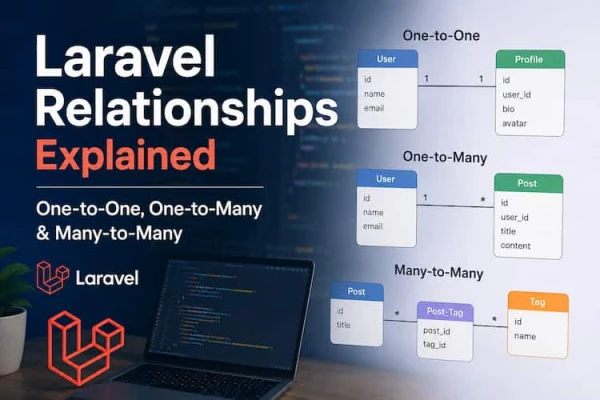
Laravel Relationships Explained: One-to-One, One-to-Many & Many-to-Many





































Discussion 0